0:00
Many users have asked me if it is worth upgrading from the Mini 2 or the Mini SE to the new Mini
0:07
3 Pro, and also which of the two models to buy as a first drone
0:12
There is obviously a big difference in terms of functionalities between the two models
0:17
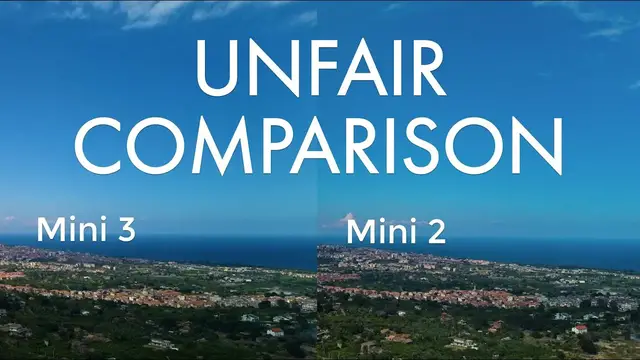
but in this video I will put them face to face, focusing only on the quality of the photos
0:23
in all different light conditions. I will also show plenty of images from the east coast of Sicily
0:38
The Mini 2 was released in November 2020. It has a 1 over 2.3 inch sensor, in more understandable terms 0.43 inches, which is really, really
0:50
small by today's standards. The aperture is fixed at f2.8. It has a field of view equivalent to 24mm and is capable of shooting photos at a resolution
1:02
of 12 megapixels. The Mini 3 Pro has a much bigger sensor at 1 over 1.3 or 0.77 inches
1:14
The aperture is fixed at f1.7, again much bigger than the one of the Mini 2
1:20
Due to sensor size and aperture, we should expect much better performance in low light
1:25
and in high dynamic range situations. The field of view is equivalent to 24mm, the same as the Mini 2, and the rear resolution
1:34
of photos is 12 megapixels. In the specs the photo resolution of the Mini 3 Pro is often stated as 48 megapixel, but
1:46
it is quite misleading. There is a 48MP mode but it is a bit of a marketing gimmick
1:54
The quad-beyer sensor is capable of splitting each pixel into four smaller ones, therefore
2:00
creating a sort of 48MP resolution, but the size of each pixel is so small that the benefits
2:07
are very limited compared to the 12MP resolution, nothing to do with a real resolution 4 times bigger
2:17
Also in the case of the Mini 3 Pro, the 48MP files show a gigantic dose of chromatic noise
2:24
in the shadows in situations of high dynamic range. Please refer to my video about photography with the Mini 3 Pro
2:32
I will post the link at the end of this one. The Mini 3 has the added benefit of shooting vertical photos and videos
2:40
It is a feature that I really appreciate for extra creativity in photography It will also be very interesting to try panoramas using vertical images Both models have the ability to shoot photos in automatic exposure bracketing
2:57
The Mini 3 Pro in this mode can take 5 shots which is the same as the bigger models
3:02
in the GI Prosumer line while the Mini 2 can only take 3 which somehow reduce the use of this
3:09
this functionality. I tend to shoot always in automatic exposure bracketing to avoid
3:15
the risk of a slightly wrong exposure. In situations of high dynamic range with both
3:21
models merging several photos to HDR often gives better results compared to single photos
3:28
I will show you some examples. As usual, let's start by watching some images taken with both drones in friendly light conditions
3:43
It is your opinion that matters the most, so let me know your impressions in the comment
3:48
below and give me a big thumb up if you find this video interesting
5:30
One thing that really bothers me with images taken with the Mini 3 Pro is an area of higher luminosity above the middle of the image when the sky is in the frame with a tendency to
5:46
a magenta cast. But that's probably not the fault of the drone, but it's rather due to the fact that my RAW
5:53
processing software doesn't have yet a color profile for this model. The RAW images taken with the Mini 2 look a bit hazy, probably due to the lens
6:04
In my opinion, DJI has recently put a lot of effort into lens design, and the ones that
6:10
equip the Earth 2S, Mavic 3 and Mini 3 Pro are much better compared to the previous models
6:18
But RAW files are not meant to be used out of the camera, and in post-processing, in
6:22
most cases, we can get rid of the haze. In a few images though we notice a severe lot of detail, like in this one
6:35
In most cases the rendition of the two models is very similar, with just a touch of extra noise in the Mini 2
6:46
We also notice that there is no degradation in the edges of the images with any of the two models
6:55
Let's turn the camera down to take the sky out of the equation and concentrate on detail
7:07
and color rendition. We end up finding that the Mini 3 Pro has just a touch more detail, but it is very, very close
7:25
We have to go to 200% crop to find a tiny difference
7:49
And now the real stress test for drone photography, shot in the direction of the sun with extremely
7:55
dynamic range. These conditions put under pressure not only the dynamic range of the sensor but also
8:02
the quality of the lens and the resistance to flare. First of all we notice that both models
8:08
benefit from shooting several images and merging them to HDR, especially the Mini 2. Therefore in
8:16
this chapter all images will be taken using this technique The lens of the Mini 2 resist quite quite well to nasty flares around the sun but the tiny sensor shows its limits There is not much detail in the shadows we notice a big loss of contrast
8:35
some color banding in the sky and a very limited range of colors
8:40
Even though the photos with the Mini 3 were taken 5 minutes before and the sun was still in the shot
8:46
the drone puts up a much better performance. The sky looks more natural, there is more detail in the shadows and the range of color is much richer
8:57
While color grading I was constantly noticing that there is very limited room to adjust colors with the Mini 2
9:06
With the Mini 3 I would recommend getting a set of ND filters
9:10
Due to the very large aperture in shots against the direction of the sun we often reach the limits of exposure
9:17
Even using the base ISO and the faster shutter speed, too much light enters the sensor and the image is still overexposed
9:33
In low light photography the Mini 2 shows its age and the extremely small size of the sensor and falls completely apart
9:40
There is a good amount of luminance noise in the sky, very little detail and plenty of
9:46
chromatic noise in the shadows, and the color rendition is poor. I simply would not use the drone for low-light photography, it's not up to today's standards
9:58
On the other hand, low-light photography is a strong point of the Mini 3 Pro
10:02
The relatively big sensor paired with a very wide aperture gathers plenty of light while
10:08
keeping the ISO value down. Noise is contained, the shadows are quite good and the color rendition is excellent
10:23
So which one to buy? Even though in easy light the Mini 2 puts up a performance better than expected, I would
10:31
only recommend it to user on a budget, getting into drones for the first time
10:38
The Mini 3 not only offers a lot of useful functions, like obstacle sensors and vertical photos
10:45
but it is also a big step up in terms of photo quality. To be honest, for someone into drone photography, the one I would really recommend is the R2S
10:57
The difference in price compared to the Mini 3 is not that much, but it is in another level in terms of photo quality
11:04
Click on this link to watch my video about photography with the Mini 3 Pro and don't
11:10
forget to hit the like button if you find this video interesting